
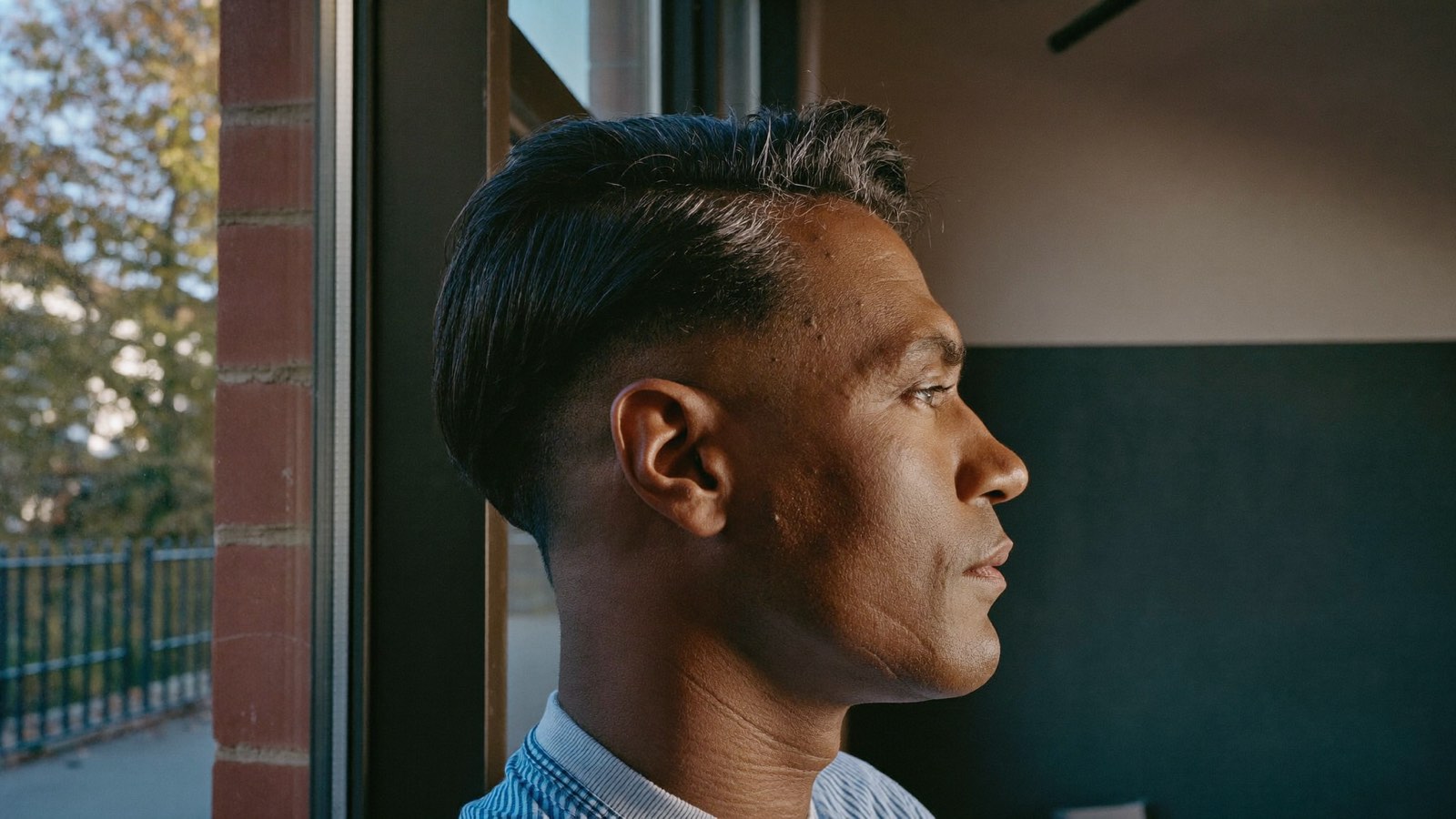
Temple point restoration rebuilds the small, forward-pointing triangles of hair that sit above each sideburn, just in front of the ears. When they thin, the face can look longer and the hairline can seem to start too far back, even if the front itself is fairly intact. With FUE, individual follicles from the back of the scalp are placed at a very flat, carefully angled direction to recreate these points. At our clinic, temple work is carried out as part of FUE hair transplant in Philadelphia.
Temple points are small, but they are among the most exacting areas to restore. This guide explains how they differ from the rest of the hairline, how to tell if yours are thinning, why placement is so delicate and the most common mistakes. For the shape of the front hairline itself, our guide to a natural hairline transplant covers design in depth.
In brief: temple points are the triangles of hair above the sideburns. Restoring them often takes a few hundred grafts per side, placed as single hairs at a very flat angle pointing down and back. Done well, they frame the face; done badly, they look like a stuck-on patch.
Temple Points vs the Temples: Two Different Areas
Temple points and the temples are often confused, but they are different areas. The temples, sometimes called the temporal corners, are where the front hairline turns back at each side; recession there gives the classic M-shaped hairline. Temple points sit lower, above the sideburns, and point forward toward the eye.
The difference matters for planning. Restoring the corners changes the shape of the front hairline, while restoring the points changes how the side of the face is framed. Many plans address both, but some people need only one. If your main concern is a receding front or a widow's peak, our article on receding hairline and widow's peak transplants covers that area.
Signs Your Temple Points Are Thinning
Thinning temple points are easy to miss in a mirror, because you usually look at yourself straight on. They show more in side views and photos. Common signs include:
- A blunt or rounded side hairline: the point above the sideburn has lost its forward tip.
- A gap between hairline and sideburn: skin shows where hair used to connect the two.
- A longer-looking face in profile: the side of the face looks more open than it used to.
- Sideburns that seem to float: they stand apart instead of flowing up into the hair above.
Temple points can thin with pattern hair loss in men, with age in both men and women, and after earlier transplants that did not address them. Comparing a side photo from several years ago with a current one is often the clearest test.
Why Temple Points Are the Most Exacting Grafts to Place
Temple points are exacting because the hair there grows almost flat to the skin and changes direction over a very small area. Hairs point down and back toward the ear at the bottom, and more forward toward the eye at the tip. Each graft has to follow that pattern closely, or it will catch the light and look out of place.
The table below shows how the temple point area compares with other parts of the hairline.
| Area | Hair direction | Placement angle | Graft type |
| Front hairline | Forward, slightly to the sides | Low | Mostly single hairs at the edge |
| Temporal corners | Forward and outward | Low | Single and some double hairs |
| Temple points | Down and back, turning forward at the tip | Very flat, close to the skin | Single hairs |
| Sideburn blend | Downward | Very flat | Single hairs |
Because single hairs are used and the area is small, graft numbers are usually modest, often a few hundred per side depending on how much is missing. Our guide to how many grafts you need sets out counts for the main zones of the scalp. At our Old City clinic, the in-house team carries out extraction and placement, and Dr. Val Prokurat, MD designs and reviews every temple plan.
Common Mistakes in Temple Work
Most poor temple results come from a handful of avoidable mistakes:
- Points set too far forward: an over-ambitious tip can look unnatural, especially as the face ages.
- Hair pointing the wrong way: grafts placed straight up or straight forward stand out against the natural down-and-back flow.
- Too dense too soon: heavy packing in this area can look like a patch rather than a gradual blend.
- Ignoring the sideburn: points that do not connect smoothly to the sideburn look detached.
- Treating points without the corners: rebuilding the points while the corners keep receding can leave an odd shape later.
Temple Points Alone or With the Hairline?
Temple points can be treated alone, but they are often planned together with the hairline. People with a stable front and a clear gap above the sideburns sometimes need temple work only. Others with a receding front gain the most from a plan that rebuilds the corners and points in one session, so the whole frame of the face is balanced.
Women also seek temple point restoration, particularly after years of tight hairstyles or age-related thinning at the sides. The plan follows the same principles, with a softer, more rounded outline. Our article on hair loss in women explains how thinning is assessed first.
What a Temple Assessment Looks At
A temple assessment looks at the side of the face as much as the front. The team checks how far the points have receded, how the sideburns connect to the hair above, the direction your remaining temple hairs grow and the caliber of donor hair, since finer hairs from the nape or behind the ears often suit this area well.
Photos are taken from both sides and from a slight angle, and a proposed outline is drawn on the skin so you can see it in the mirror before anything is decided. The goal is a shape that matches your age and face, with points that soften the frame rather than dominate it. If your front hairline is still receding, the plan also allows for that, so the temples will still look right as the years go by.
Healing and Growth at the Temples
The temples are one of the most visible areas, so healing is worth planning around. Small crusts form around each graft and usually clear within about 7 to 14 days; longer hair above can help soften their look in the first week. Transplanted hairs commonly shed within the first month, then regrow over the following months. Our guide to the transplant timeline month by month walks through each stage.
Because temple hairs are fine and grow flat, it can take most of the year before the points look fully natural. Short haircuts at the sides are best kept a little longer during this time so the new hairs can blend in as they grow.
Cost and Planning in Old City
Temple point restoration is priced per graft, at $3.99 to $7.99, with most procedures between $4,000 and $15,000, no session fees and 0% financing for the first 12 months. Temple-only plans tend to sit toward the lower end of that range because graft counts are modest. The hair transplant cost page explains how a quote is built.
Have Your Temples Assessed
Book a free consultation at 325 Chestnut St in Old City. We look at your temple points, sideburns and hairline together, explain what restoring them would involve and give you a written graft estimate and quote. Call (267) 996-9966.
Further reading: for independent background, see American Academy of Dermatology: hair loss, MedlinePlus: hair loss and International Society of Hair Restoration Surgery (ISHRS).